| Hope all of you had a wonderful Dasara! This year, my husband and I set up a small "Children's Golu" for my son. I call it that because I did not have the traditional dolls with me and so the children's park and zoo became the main theme. I also had to keep it safe for my eight month old daughter. The display turned out quite well and we all had a fun time. I look forward to doing it again, perhaps bigger next year. | |
| Anyways, I wanted to highlight a couple of filling stitches that I used in the "Kalasha" Embroidery. One is the Satin Stitch used for the mango leaves and the other is the Long and Short Stitch used for the coconut. The tutorials for both are posted in the Stitches section. Check them out! |  |
| Satin stitch, also known as Damask Stitch works very well as a filling stitch. It provides a smooth finish, and since the stitches are all so close together the texture of the thread can be used to its advantage. Satin Stitch is used In Indian Embroidery quite a bit. This stitch has a lot of variants and the Long and Short stitch is one of them. The long and short stitch is also great for covering large areas. I used this stitch in just one color, brown, along with a few streaks of black, but this stitch is more effective when used in creating those subtle shades that you see in nature. It really brings a leaf, a flower and other such elements to life. | |
Tutorial Picture of Satin Stitch
| Tutorial Picture of Long and Short Stitch.
|
A glimpse of our display. I will leave the rest to your imagination!! :) Have a nice week, everyone! | |
. 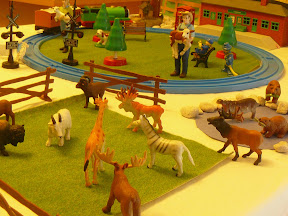 | 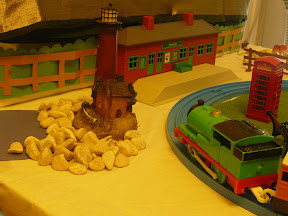 |

10/5/09
A closer look at the Dasara Embroidery...
.JPG)
.JPG)
9/20/09
Happy Dasara!

Dasara brings such warm memories of childhood that it makes me want to be a kid again! Today's embroidery, 'Kalasha' is symbolic of Dasara as it is celebrated in South India. 'Kalasha' is a metal pot inside which are a few neatly tucked mango leaves and a coconut in the center. To me the embroidery also reminds me of my grandma. She lived in Chennai and would visit us every summer. During her stay, she would make me a special 'Kalasha' for the 'Golu' (Another South Indian tradition of proudly displaying one's collection of clay dolls, heirloom artifacts, travel souvenirs in steps). In our house, the centre piece was always grandma's meticulously decorated 'Kalasha' made from a few simple things - plastic pot, rubber ball, large gold sequins and of course, tons of pins!!
Well, whatever fond memories Dasara may bring to you, here is wishing everyone a Happy festival season!
9/10/09
From the City of the Nawabs...
| Today, we travel to Lucknow, a busy city in the state of Uttar Pradesh. This city is worth visiting for two reasons. One, the amazing monuments and second, (more important!) to shop for some beautiful Chikankari work. Chikankari is the Indian version of Whitework and Shadow work. The designs used are generally flowers and creepers. Another very common design is the mango. The embroidery is done predominently using white cotton thread on white fabric and other pastel shades of fabrics. This style also seems to fit the description of Shadow work because it is done on transparent and semi transparent fabrics like poplin, voile and chiffon. There are many stitches used in Chikankari, some specifically for the outlines, and others for filling the pattern to create the shadow. Besides this, there are the raised stitches that stand out quite well against the flat stitches and of course the jali work. I have barely scratched the surface of this style and I have a long way to go in exploring and experimenting. Take a look at today's samples. | ||
| ||

 |  |
| This is my first creation! It was done on a semi transparent cotton fabric. The primary stitch used here is Double back stitch worked with two strands of white embroidery floss. And the needle is just the regular crewel needle. You will get the same result with the Herringbone Stitch, but then you would have to work with the reverse side of the fabric facing you. You can see the holes that the stitches have made in the picture on the right. Creating holes is part of Chikankari. | |
This is also done in Double back stitch using two strands of white embroidery floss.
 | |
| Chikankari is unforgiving of knots. Take the time to make small knots. Another note - let's say you are making a flower. When you finish one petal, weave your needle through the petal to start the next one. If not, the ugly long piece of thread will show through!! Well, I hope I have inspired you to try Chikankari. Happy embroidering! | |
| You might also be interested in... | |
.JPG) | .JPG) |
| Embroidered Pillow Cases | Samples of Arhi Work |
Subscribe to:
Posts (Atom)